
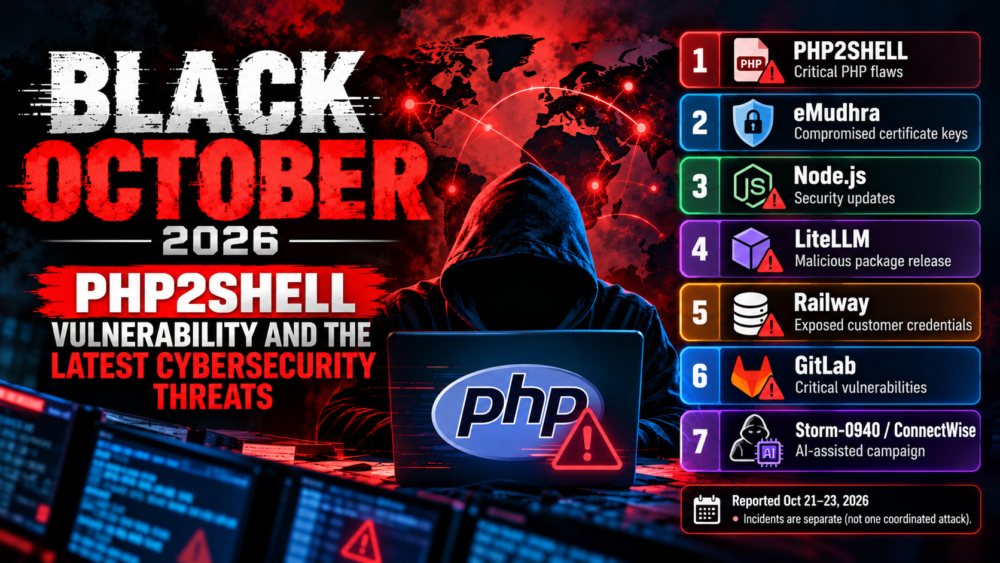
Black October 2026 has become a major talking point in cybersecurity as a series of critical software vulnerabilities, compromised software packages, credential exposure incidents, and active cyberattack investigations have emerged during October. From the PHP2Shell vulnerability to a compromised AI software package and a cloud service security incident, the latest disclosures highlight the growing risks facing websites, developers, businesses, and cloud infrastructure.
Between October 21 and October 23, security researchers and technology companies reported several important developments involving PHP, Node.js, eMudhra, LiteLLM, Railway, GitLab, and a cyber campaign associated with Storm-0940 and ConnectWise. Some reports concern newly disclosed vulnerabilities, while others reveal compromises or suspicious activity that began earlier.
These incidents do not necessarily share a common attacker or cause. However, their concentration has made October an important period for organizations reviewing their cybersecurity defenses.
In this news update, we examine seven significant cybersecurity developments, explain their potential impact, and outline the steps organizations should take to reduce their exposure.
Table of Contents
1. PHP2Shell Vulnerability Raises Critical Server Security Concerns
One of the most urgent developments during Black October is the disclosure of two critical vulnerabilities in the PHP programming language.
Announced on October 21, 2026, the vulnerabilities are tracked as CVE-2026-109618 and CVE-2026-109619. They affect the PHP runtime, which powers many websites and web applications, including installations of popular content management systems.
The vulnerabilities have been assigned a reported CVSS 4.0 severity score of 9.2, placing them in the critical category. Under affected conditions, successful exploitation could allow an attacker to execute arbitrary code on a vulnerable server without authentication.
Why is PHP2Shell dangerous?
PHP2Shell concerns weaknesses in memory handling that can affect vulnerable PHP processes.
If an attacker successfully exploits the flaws, the consequences may extend beyond a website displaying an error or behaving unexpectedly. Depending on the environment and the privileges available to the PHP process, exploitation could enable unauthorized code execution and further compromise.
Potential consequences include:
- Unauthorized access to application data.
- Theft of credentials and authentication tokens.
- Installation of malicious scripts.
- Modification of website files.
- Further access to vulnerable server environments.
The precise impact depends on the PHP version, server configuration, and existing security controls.
Exploitation attempts reported
Amazon Threat Intelligence reported observing an attempted PHP2Shell exploit against its MadPot honeypot infrastructure on October 17, before the vulnerabilities were publicly disclosed.
Following the October 21 disclosure, further attempts were observed. These findings suggest that at least some threat actors may have learned about the vulnerabilities before public disclosure, although the precise source of that knowledge has not been established.
How can website owners protect themselves?
The PHP project released patched versions for supported branches:
Administrators should verify these releases against the official PHP security advisory before updating.
Website owners should check the PHP runtime used by their production sites, apply the appropriate security patch, and restart affected processes where necessary. Those using managed hosting should contact their provider to confirm whether the underlying runtime has been updated.
Updating WordPress or another content management system alone does not necessarily patch the PHP runtime beneath it.
2. eMudhra Certificate Security Incident Raises Trust Concerns
The second major development involves eMudhra, an Indian digital certificate provider.
Digital certificates help establish trust between websites, applications, and users. They play an important role in encrypted communications, website identity verification, and other security-sensitive operations.
During October, researchers identified weaknesses affecting eight intermediate certificate authority keys associated with eMudhra. Reporting indicated that the keys could be recovered because of serious weaknesses in their generation, potentially allowing attackers to create certificates that other systems might trust.
Why does a certificate authority compromise matter?
Certificate authorities help maintain the trust infrastructure used across the internet.
If a certificate authority’s signing keys are compromised, affected certificates may be misused to impersonate websites or services, depending on the certificate’s purpose and the trust relationships involved.
This type of incident can affect more than the organization that issued the certificates. It may also require action from browser vendors, operating system developers, application maintainers, and website operators.
What should organizations do?
Organizations should:
- Review official advisories from their certificate provider.
- Identify certificates that may chain to affected certificate authorities.
- Follow instructions for replacing or revoking affected certificates.
- Update relevant operating systems, browsers, and application trust stores.
- Review security logs for suspicious certificate or identity-related activity.
Not every certificate associated with a provider should automatically be assumed compromised. Organizations need to determine whether their own certificates are affected and follow the applicable remediation guidance.
The eMudhra incident also highlights a broader lesson: digital trust depends on the security of the infrastructure responsible for issuing and validating certificates.
3. Node.js Releases Emergency Security Updates
Node.js was another major focus of the October cybersecurity disclosures.
On October 21, the Node.js project released security updates addressing ten vulnerabilities across supported release branches. Four were classified as high severity. The updates also addressed certificate trust concerns associated with the eMudhra incident.
Node.js is widely used to build web applications, APIs, backend services, and developer tools. Consequently, vulnerabilities in the runtime can affect a broad range of production environments.
What risks do the vulnerabilities present?
The reported issues include weaknesses involving TLS hostname verification, DNS handling, and the Brotli decompression process.
Depending on the vulnerability and configuration, these weaknesses could affect the security of network communications or application processes. The most serious memory-handling issues may create opportunities for code execution under affected conditions.
The security releases include:
Administrators should confirm the applicable version and support status through the official Node.js security release information before deploying updates.
What should developers do?
Developers and system administrators should:
- Check which Node.js versions are used in production.
- Upgrade affected installations to appropriate patched releases.
- Rebuild containers and deployment images using the updated runtime.
- Review application dependencies and certificate trust configurations.
- Check whether any unsupported runtime versions remain in use.
Updating a developer’s local machine is not sufficient if the production environment continues running a vulnerable version.
The Node.js disclosures demonstrate why runtime maintenance is an important part of a comprehensive cybersecurity strategy.
4. LiteLLM Supply Chain Attack Exposes Sensitive Credentials
A particularly concerning incident involved LiteLLM, a software package used to connect applications with large language models and other AI services.
Security reporting on October 21 revealed that the LiteLLM 1.107.0 release distributed through package and container registries contained malicious functionality designed to steal credentials and load additional code.
The incident was linked to compromised developer credentials and manipulation of a software release workflow. Investigators reported that the malicious package could expose sensitive information accessible to the affected environment.
How did the supply chain attack work?
Software supply chain attacks target trusted software, vendors, development environments, or distribution mechanisms to reach downstream users.
Instead of attacking every customer individually, an attacker may compromise a software release process and distribute malicious code through a channel that customers normally trust.
In the LiteLLM incident, the malicious release reportedly included credential-stealing functionality and a mechanism for loading additional code.
Potentially exposed information included:
- Cloud service credentials.
- SSH keys.
- API tokens.
- AI service secrets.
- Other credentials accessible to the affected environment.
The actual impact depends on the systems that installed the affected release and the permissions available to the compromised process.
What should affected users do?
Organizations that installed LiteLLM 1.107.0 from an affected distribution channel should treat the environment as potentially compromised.
Recommended actions include:
- Follow the vendor’s incident-response guidance.
- Rebuild affected environments from a known-clean source.
- Rotate potentially exposed credentials from a clean system.
- Review cloud audit logs for suspicious access.
- Inspect development and deployment pipelines for unauthorized changes.
- Avoid running package-management commands in a potentially contaminated environment until it has been assessed.
The vendor identified LiteLLM 1.106.2 as a safe version in its incident guidance at the time of reporting. Users should verify current vendor instructions before rebuilding their environments.
The key lesson: A trusted software package can become an attack vector when its release process is compromised. Dependency verification and secure release management are essential defenses.
5. Railway Security Incident Prompts Credential Resets
Railway, a cloud platform used to deploy and manage applications, reported a security incident during the October cybersecurity wave.
On October 22, reporting indicated that Railway had reset certain customer credentials following the incident. The disclosure raised concerns about the potential exposure of secrets stored within customer environments.
Cloud platforms frequently store sensitive configuration information, including database passwords, API keys, deployment tokens, and application credentials.
If an attacker obtains access to these secrets, the consequences may extend beyond the original hosting platform.
Why exposed cloud credentials are dangerous
Compromised credentials can allow attackers to access connected systems without exploiting a separate software vulnerability.
Depending on the permissions associated with the credentials, an attacker may be able to:
- Access databases and application services.
- Connect to third-party APIs.
- Modify application deployments.
- Access cloud resources.
- Read or alter sensitive information.
However, a report of potential credential exposure does not automatically establish that every customer account was accessed or that every stored secret was stolen.
The extent of the impact depends on the incident’s scope and the permissions available to the affected credentials.
Recommended security actions
Railway users should review official platform communications and follow the provider’s instructions.
As a precaution, affected organizations should:
- Identify sensitive credentials stored in their environments.
- Rotate potentially exposed secrets.
- Review application and cloud audit logs.
- Check for unexpected deployments or configuration changes.
- Remove unnecessary permissions from service accounts.
- Verify that replacement credentials are not exposed in source code or logs.
Changing a password alone may not be enough if API keys, database credentials, or deployment tokens were also exposed.
The Railway incident illustrates why cloud security must include both access controls and effective secrets management.
6. GitLab Vulnerabilities Put Self-Managed Instances Under Scrutiny
GitLab was another significant part of the Black October security picture.
Security reporting highlighted a critical vulnerability tracked as CVE-2026-110264, with a reported CVSS score of 10.0. The vulnerability was described as affecting self-managed GitLab instances and potentially allowing unauthenticated remote code execution under affected conditions.
GitLab is widely used for source-code management, collaboration, continuous integration, and software deployment. A compromise of a GitLab instance can therefore put more than the application itself at risk.
Depending on the environment, attackers may gain access to source code, pipeline configurations, deployment secrets, or systems connected to the development workflow.
Why is a GitLab vulnerability especially serious?
Development platforms often have access to sensitive resources, including:
- Private source-code repositories.
- CI/CD variables and deployment tokens.
- Build and release pipelines.
- Cloud deployment credentials.
- Internal project information.
If an attacker compromises a self-managed instance, these connections may provide opportunities to access additional systems.
This does not mean every vulnerable instance has been compromised. The risk depends on the affected version, exposure, configuration, and whether exploitation occurred.
What should GitLab administrators do?
Administrators should:
- Check their GitLab version and applicable security advisory.
- Apply the vendor’s patched release.
- Restrict unnecessary public access to administrative interfaces.
- Review authentication and audit logs.
- Investigate unexpected pipeline or repository changes.
- Rotate secrets if compromise is suspected.
The reported issue makes patch management especially important for organizations that expose self-managed GitLab instances to the internet.
Because the vulnerability is associated with potentially severe consequences, administrators should consult the official GitLab advisory for the exact affected and fixed versions rather than relying on unofficial version lists.
7. Storm-0940 and ConnectWise: AI-Assisted Cyber Operations Under Investigation
The seventh development involves Storm-0940, a threat actor that Microsoft describes as aligned with the Chinese state, and a reported compromise involving ConnectWise’s cloud services.
On October 21, Microsoft published findings describing how Storm-0940 used an AI-assisted penetration-testing framework called ARTEX to automate reconnaissance and other attack activities.
Microsoft also linked the threat actor to a previously disclosed ConnectWise supply chain compromise involving unauthorized access to customer environments. The reported activity extended beyond October 21, with some campaign activity beginning as early as September 2026.
How is AI being used in cyberattacks?
AI-assisted tools can automate parts of offensive security workflows, including reconnaissance, vulnerability investigation, and authentication-related operations.
In the activity described by Microsoft, ARTEX was used to accelerate scanning, password-spraying attempts, and OAuth application abuse.
The ConnectWise incident is particularly significant because cloud applications may have permissions to access customer environments. If an attacker compromises a trusted application identity, those existing permissions may provide a path into downstream systems.
Microsoft reported that some activity led to privileged access in affected cloud environments. However, the presence of a compromised application or successful authentication does not, by itself, prove that customer data was accessed or exfiltrated.
Why is this a concern for businesses?
Organizations increasingly rely on third-party services to manage backups, security, infrastructure, and business operations.
A compromise affecting a trusted service provider can create risks across multiple customer environments, particularly when application identities have extensive permissions.
AI-assisted automation may also increase the speed at which attackers conduct certain operations, leaving defenders less time to investigate suspicious activity and remove unauthorized access.
Recommended security measures
Organizations using affected ConnectWise services should follow the provider’s official containment guidance and Microsoft’s recommendations.
Security teams should:
- Review service-principal sign-in activity.
- Investigate unexpected OAuth application changes.
- Examine modifications to application credentials and privileges.
- Look for unusual Microsoft Graph activity.
- Review identity and directory changes.
- Preserve relevant logs for incident investigation.
- Remove unauthorized access and rotate affected credentials.
Organizations should not assume that every ConnectWise customer has been compromised. They should assess their own exposure using official indicators and incident-response guidance.
The incident demonstrates that AI-assisted cyber operations and third-party application compromises are important risks to consider, even when there is no evidence that all affected organizations suffered data theft.
Black October 2026: Seven Cybersecurity Incidents at a Glance
The following table summarizes the seven developments covered in this report.
These incidents differ in their technical details, scope, and evidence of exploitation. They should not be treated as seven confirmed data breaches or as components of one coordinated campaign.
How to Protect Your Website and Business During Black October
The latest cybersecurity reports highlight the importance of taking practical steps to protect websites, development systems, and cloud infrastructure.
Organizations do not need to panic, but they should review their exposure and prioritize actions based on the systems they use.
1. Patch vulnerable software
Check PHP, Node.js, GitLab, and other internet-facing applications against their official security advisories.
Prioritize vulnerabilities that affect your environment, especially when exploitation has been reported or the affected service is publicly accessible.
2. Review software dependencies
Identify affected package versions and deployment images.
If you installed a potentially malicious software release, do not assume that updating the package alone will clean the environment. Investigate possible compromise and rebuild from a trusted source when necessary.
3. Rotate potentially exposed credentials
Review API keys, cloud credentials, database passwords, SSH keys, deployment tokens, and OAuth application secrets.
Rotate credentials when the incident guidance indicates potential exposure or your investigation identifies suspicious access. Perform sensitive remediation from a clean environment.
4. Check authentication and access logs
Review successful and failed sign-ins, service-principal activity, administrator changes, and unexpected deployments.
Pay particular attention to unusual authentication patterns and changes to permissions or application credentials.
5. Secure certificate trust
Follow advisories from certificate providers, browser vendors, and runtime maintainers.
Determine whether your certificates or trust stores are affected, and replace or update them according to the applicable guidance.
6. Protect your development pipeline
Limit access to source-code repositories and release workflows.
Use multifactor authentication, protect developer credentials, review package sources, and restrict deployment secrets to the services that actually require them.
7. Maintain reliable backups
Keep protected backups of important website files, databases, and configuration data.
Test restoration procedures regularly. If a compromise occurs, verify that restored systems are clean before reconnecting them to production services.
What Happens Next?
The cybersecurity developments associated with Black October are likely to remain relevant as researchers investigate the incidents, organizations deploy patches, and vendors publish additional information.
The immediate priorities differ across the seven cases.
PHP and Node.js administrators should verify their runtime versions and install applicable security updates. GitLab administrators should check their exposure to the reported vulnerability. Organizations that installed the malicious LiteLLM release need to consider both system recovery and credential rotation.
Users of Railway and affected ConnectWise services should follow official incident-response guidance, while organizations that rely on eMudhra-issued certificates should determine whether their own certificates or trust stores require changes.
These actions address different risks. A software patch can close a vulnerability, but it does not automatically revoke stolen credentials, remove an existing backdoor, or undo unauthorized changes made before the update.
For this reason, organizations should combine patching with log analysis, credential management, and incident investigation.
Conclusion: Black October Is a Wake-Up Call for Cybersecurity
Black October 2026 highlights how quickly multiple cybersecurity concerns can emerge across software, cloud infrastructure, and digital trust systems.
The PHP2Shell vulnerabilities have put PHP server security under renewed scrutiny. The eMudhra incident has raised questions about certificate trust, while the Node.js and GitLab disclosures emphasize the need for timely software updates.
The LiteLLM supply chain compromise and Railway security incident demonstrate why credentials and cloud environments require careful protection. Meanwhile, the Storm-0940 and ConnectWise reporting illustrates how third-party access and AI-assisted automation can complicate incident response.
Although the seven developments are not necessarily connected, they share a practical lesson: cybersecurity requires more than installing updates and hoping for the best.
Organizations must understand which systems they use, verify whether they are affected, deploy the appropriate fixes, protect credentials, and investigate signs of unauthorized access.
For website owners and developers, the best starting point is straightforward: check your software versions, review official security advisories, and address any confirmed exposure without delay.
As new information emerges, this article should be updated to reflect verified developments and changes to remediation guidance.
Sources and References
The following sources provide additional information about the cybersecurity incidents discussed in this report. Consult the original advisories for confirmed details, affected versions, and recommended remediation steps.
1. PHP2Shell Vulnerabilities
- Amazon Web Services (AWS) Security Blog — PHP2Shell Exploitation Activity
- Canadian Centre for Cyber Security — PHP Vulnerability Advisory
2. eMudhra Certificate Security
3. Node.js Security Updates
4. LiteLLM Supply Chain Incident
5. Railway Security Incident
6. GitLab Security Vulnerabilities
7. Storm-0940 and ConnectWise
Additional Cybersecurity Resources
- CISA — Cybersecurity Advisories
- NIST National Vulnerability Database
- OWASP — Web Application Security
Editorial note: Security incidents, vulnerability identifiers, affected versions, and remediation recommendations can change as investigations progress. Some incidents discussed in this article may have begun before October 21–23, 2026. Verify incident-specific claims against the relevant vendor advisories before relying on them.